
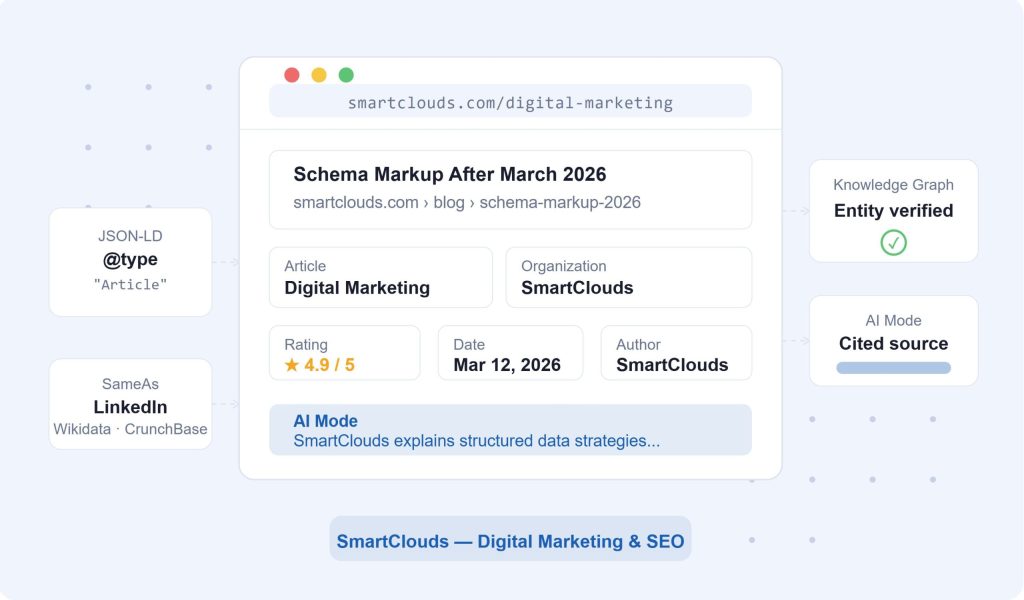
Google's March 2026 update tackled two overlapping problems it had been tracking for years: schema abuse on pages where markup didn't match the primary content, and the disconnect between traditional rich result optimisation and AI Mode source selection.
The core strategic shift is this — schema is no longer just a SERP display trigger. It is now a trust and entity verification signal that Google's Gemini-powered AI Mode reads when deciding which sources to cite in AI-generated answers. For digital marketing professionals, this changes how you measure schema ROI.
ℹ️ AI Mode doesn't display schema as a rich result. It reads schema to understand what your page is about, who wrote it, and how authoritative those entities are — even when no visible SERP feature is triggered.
Of the 31 schema types that retain active rich result support, the strongest performers are those tied to clear user intent — product availability, event timing, recipe details, and local business info. Here's a breakdown:
The single most impactful schema change available today is not tied to a content type — it's the entity markup that identifies your organisation as a verified entity in Google's Knowledge Graph. Sites with clean entity schema are cited more frequently in AI answers because the AI can confidently resolve who the source is.
The SameAs property is the connective tissue between your website and the Knowledge Graph. Point it to Wikidata, LinkedIn, Crunchbase, and official business registrations. The knowsAbout property tells AI Mode which topic domains — like digital marketing, cloud infrastructure, or SaaS — your organisation genuinely has expertise in.
Google's Gemini-powered AI Mode uses structured data as an input to answer generation, not just a rich result trigger. This means schema that never produces a visible SERP feature can still materially influence whether your content is cited in AI answers — a critical insight for any digital marketing strategy targeting informational queries.
Three schema types are especially valuable for GEO (Generative Engine Optimisation):
Flags the most citable passage within long-form content. Signals to AI Mode which section best answers the target query and improves citation precision.
For fact-checking and research content. AI Mode treats ClaimReview pages as high-trust sources for verification queries — valuable for authoritative digital marketing content.
Mark glossary entries and technical definitions. Positions industry glossary pages as authoritative definition sources, especially useful for digital marketing and tech topics.
Here is a phased implementation plan to bring your schema up to the post-March 2026 standard:
Crawl all pages to inventory existing schema types. Cross-reference Search Console Enhancements for errors. Flag all FAQ, Review, and How-To implementations for content-intent review. Check Organization schema for SameAs completeness.
Remove or correct non-compliant FAQ, Review, and How-To markup. Build comprehensive Organization entity schema with all SameAs sources. Add Person/Author schema with SameAs for all primary content creators.
Track rich result impressions, Knowledge Panel accuracy, and AI Mode citation rates. Google's processing of schema changes can take weeks. Run quarterly schema reviews aligned with Search Console reporting.
Ready to audit your schema implementation?
SmartClouds helps businesses stay ahead of Google's evolving structured data requirements — combining digital marketing expertise with technical SEO execution.
Get in touch →